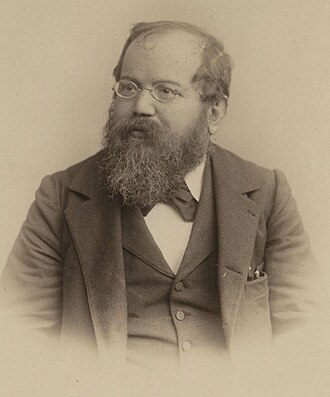
World Champion 1886–1894
Wilhelm Steinitz
Austria, United States · 1836–1900
Wilhelm Steinitz was the first official World Chess Champion and the founder of the modern positional school, which replaced the all-out attacking style of the Romantic era with principled, scientific play.
Career highlights
- First official World Chess Champion, 1886–1894
- Pioneer of positional, scientific chess theory
- Undefeated in serious match play for over twenty years before 1894
Early Life
Wilhelm Steinitz was born in Prague in 1836, then part of the Austrian Empire, the youngest surviving child of a large and impoverished Jewish family. He left for Vienna in 1858 to study mathematics at the Polytechnic, but the chess tables of the city’s coffee houses soon claimed him entirely. Within a few years he was the strongest player in Austria and had adopted chess as his profession — a precarious living that would shadow him for the rest of his life.
Rise to the Top
Steinitz announced himself on the international stage at the London tournament of 1862 and settled in England, where he made his name as a fearsome attacking player in the Romantic tradition. Through a series of head-to-head matches he dismantled the era’s leading masters one by one — Adolf Anderssen in 1866 chief among them — establishing himself as the man to beat in serious match play.
The road to a world title
For two decades Steinitz lost no match of consequence. By the 1880s the idea of a formal “World Championship” had taken shape around him, and his long-running rivalry with Johannes Zukertort set the stage for a contest both men agreed would settle the question of who was best.
World Champion
In 1886 Steinitz defeated Zukertort in a match played across New York, St. Louis, and New Orleans, a result now universally recognized as the first official World Chess Championship. He held the title for eight years, defending it successfully against Mikhail Chigorin (twice) and Isidor Gunsberg, before age and the relentless preparation of a younger challenger caught up with him.
Losing the crown
In 1894 the 58-year-old champion was beaten decisively by the 25-year-old Emanuel Lasker. A rematch in 1896–97 went even worse, and Steinitz’s health and finances declined sharply thereafter. He died in New York in 1900, impoverished but already recognized as a giant of the game.
Playing Style
The young Steinitz had been a dashing attacker, but his lasting contribution was a revolution in chess thought. He argued that the attack was not a matter of romantic daring but a logical consequence of accumulated advantages — superior pawn structure, control of key squares, the bishop pair, a safer king. Defend soundly, gather small edges, and the winning attack would arrive of its own accord.
Legacy
Steinitz is rightly called the father of modern, positional chess. His “scientific” principles, developed further by Siegbert Tarrasch and later refined by every champion who followed, form the bedrock of strategic understanding to this day. The first man to be called World Champion was also the first to explain why the strongest move was strongest.
Portrait via Wikimedia Commons.