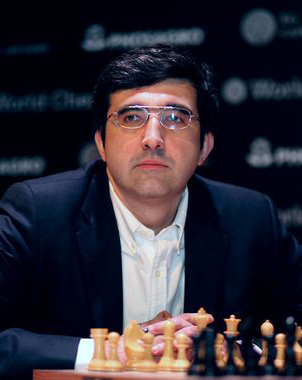
World Champion 2000–2007
Vladimir Kramnik
Russia · 1975
Vladimir Kramnik ended Garry Kasparov's fifteen-year reign in 2000 and later unified the world title, a deep strategist whose preparation neutralized the strongest attacker of the age.
Career highlights
- Classical World Champion 2000–2007
- Defeated Garry Kasparov in 2000 without losing a game
- Unified the world title in 2006
Early Life
Vladimir Kramnik was born in Tuapse, on Russia’s Black Sea coast, in 1975. He trained at the Botvinnik–Kasparov school and burst onto the international scene as a teenager, his calm temperament and profound positional understanding marking him as a future champion. Garry Kasparov himself helped select the young Kramnik for the 1992 Olympiad team, where he scored brilliantly.
Rise to the Top
Through the 1990s Kramnik established himself as one of the very best players in the world, a frequent rival of Kasparov in elite tournaments and a renowned theoretician with a gift for deep, original opening preparation.
World Champion
Dethroning Kasparov
In 2000 Kramnik challenged Kasparov for the classical world title in London. In one of the great strategic triumphs in championship history, he neutralized the sport’s most fearsome attacker with the rock-solid Berlin Defence; Kasparov, unable to win a single game, lost his title after fifteen years at the top.
Defending and unifying
Kramnik defended the classical title against Peter Leko in 2004, surviving with a win in the final game. Then, in 2006, he defeated FIDE champion Veselin Topalov in a tense reunification match to become the first undisputed World Champion since the schism of 1993. He held the unified crown until Viswanathan Anand took it in 2007.
Playing Style
Kramnik was a deep strategist with an exceptional feel for structure and the initiative. His preparation reshaped opening theory — he revived the Berlin Defence and the Catalan as modern main-line weapons — and his patient, technical style made him extraordinarily hard to beat.
Legacy
After retiring from classical play in 2019, Kramnik remained an influential voice in the game, particularly on questions of fair play and the future of online chess. His unification of the title closed one of the most divisive chapters in the sport’s history, and his theoretical innovations continue to shape how the game is played at the highest level.
Portrait via Wikimedia Commons.