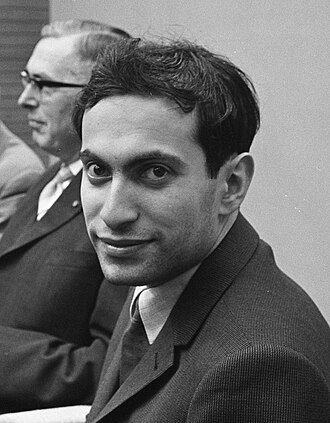
World Champion 1960–1961
Mikhail Tal
Soviet Union · 1936–1992
Mikhail Tal, the "Magician from Riga," was the youngest World Champion of his time and the most spectacular attacking player in history, famous for daring, intuitive sacrifices that defied calculation.
Career highlights
- World Champion 1960–1961 — then the youngest ever
- Most celebrated attacking and sacrificial player in history
- Held a record unbeaten streak of 95 games
Early Life
Mikhail Tal was born in Riga, Latvia, in 1936. A frail, brilliant child who battled ill health throughout his life, he was a prodigy in school and at the chessboard alike. From the start his style was unlike anyone else’s — intuitive, combinative, and gloriously unafraid of risk.
Rise to the Top
Tal exploded onto the Soviet scene in the late 1950s, winning the Soviet Championship in 1957 and again in 1958, then sweeping through the Candidates cycle in 1959 ahead of a field that included the young Bobby Fischer. His sacrifices bewildered even the world’s strongest players.
World Champion
The youngest champion of his time
In 1960, at just twenty-three, Tal defeated Mikhail Botvinnik to become the youngest World Champion to that point. The match was a showcase of his daring, attacking genius.
A brief reign
The crown lasted only a year. Botvinnik, far better prepared and helped by Tal’s chronic kidney illness, won the 1961 rematch convincingly. Tal never regained the title, but his health, not his strength, was his true opponent.
Playing Style
Tal was the most spectacular attacking player the game has ever seen, the “Magician from Riga.” He sacrificed material to drag opponents into a maelstrom of complications that he, almost alone, could navigate. Many of his sacrifices were objectively unsound, yet practically irresistible — he won because his opponents could not find the refutation across the board.
Later Life and Legacy
Despite recurring illness, Tal remained a feared competitor for decades, setting a record unbeaten streak of ninety-five consecutive games in 1973–74 and dominating blitz and rapid play. Warm, witty, and beloved throughout the chess world, he died in 1992. His games are still studied not as models of correctness but as pure inspiration — proof of how thrilling chess can be.
Portrait via Wikimedia Commons.