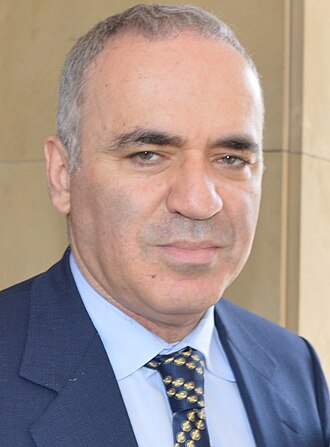
World Champion 1985–2000
Garry Kasparov
Russia, Soviet Union · 1963
Garry Kasparov was the dominant chess player of the late twentieth century, World Champion from 1985 to 2000 and the world's number-one player for two decades.
Career highlights
- World Chess Champion 1985-2000
- Held the highest rating in the world from 1986 to his retirement in 2005
- Defeated Anatoly Karpov in five consecutive World Championship matches
- Peak Elo rating of 2851 in July 1999
- Won Linares super-tournament a record nine times
Early Life
Garik Kimovich Weinstein was born in Baku, Azerbaijan, in 1963, to an Armenian mother and a Jewish father. He took his mother’s surname, Kasparian — later Russified to Kasparov — after his father’s death when he was seven. He learned chess by watching his parents solve a problem from a newspaper. By the age of ten he had been admitted to Mikhail Botvinnik’s prestigious chess school, where the former World Champion personally guided his early development.
By 1976, at thirteen, Kasparov had won the Soviet Junior Championship. By 1980 he was a Grandmaster — the youngest in the world at the time.
Rise to Prominence
Kasparov’s rise was meteoric even by Soviet standards. He won the Soviet Championship in 1981 at age eighteen, becoming the youngest player ever to do so. International success followed at Bugojno and Tilburg, and by 1984 he had emerged from the Candidates cycle as the challenger to reigning World Champion Anatoly Karpov.
The first Kasparov–Karpov match, held in Moscow that autumn, became the longest title match in chess history. After six months and forty-eight games, with Karpov leading 5-3 but visibly exhausted, FIDE President Florencio Campomanes controversially terminated the match without a result. The decision shocked the chess world and laid the groundwork for the rematch in 1985.
Peak Career
In November 1985 Kasparov won the rematch in Moscow, becoming, at twenty-two, the youngest undisputed World Champion in history. Over the next five years he defended his title four times against Karpov — in 1986 (London/Leningrad), 1987 (Seville), 1990 (New York/Lyon), and held the championship through a near-unbroken streak of tournament victories.
His dominance extended well beyond match play. From January 1985 until his retirement two decades later, Kasparov was the world’s top-rated player almost without interruption. His peak rating of 2851 in July 1999 stood as the highest in history for twenty-one years, until broken by Magnus Carlsen in 2013.
Kasparov’s chess was defined by relentless opening preparation — he and his team, including Vladimir Kramnik and Yuri Dokhoian, treated home analysis as a science — paired with a willingness to commit early to forcing, attacking plans. The 1999 Wijk aan Zee game against Veselin Topalov, in which 24.Rxd4 began a twenty-move forcing sequence with sacrifices of rook, pawn, and king safety, became known simply as Kasparov’s Immortal.
In 1993 he broke with FIDE over financial and organizational disputes, founding the Professional Chess Association and defending his title outside the FIDE structure for the rest of the decade. The split created two parallel champions and complicated his legacy in the eyes of FIDE-aligned historians, but did not dent his sporting dominance.
His title reign ended in 2000, when his former second Vladimir Kramnik defeated him in London. Kasparov never recovered the crown — he retained the world’s highest rating but lost two further match opportunities — and in 2005, after winning Linares for the ninth time, he retired from professional chess.
Later Career
Since retirement Kasparov has remained a public figure as a political activist, opposing Vladimir Putin and the Russian government, and as a writer. His multi-volume series My Great Predecessors and Garry Kasparov on Modern Chess are widely regarded as the most ambitious surveys of chess history ever written.
He briefly attempted a return to the FIDE presidency in 2014, losing to Kirsan Ilyumzhinov. He has played occasional rapid and blitz tournaments since, including the 2017 Saint Louis Rapid & Blitz, where he finished mid-table against a younger generation that had grown up studying his own games.
Legacy
Kasparov’s combination of preparation, calculation, and competitive ferocity reshaped what professional chess looked like. The opening files of every modern grandmaster trace back to ideas he and his team pioneered in the 1980s and 1990s. The current generation — Carlsen, Caruana, Nepomniachtchi, Ding — grew up studying his games as primary texts.
His matches against IBM’s Deep Blue in 1996 and 1997 became the first widely-followed confrontation between a human world champion and a chess engine. He won the first match and lost the second, an outcome that closed one chapter of computer-chess history and opened another.
He sits, with Bobby Fischer and Magnus Carlsen, on most informed lists of the three greatest players in the game’s history.
Portrait via Wikimedia Commons.