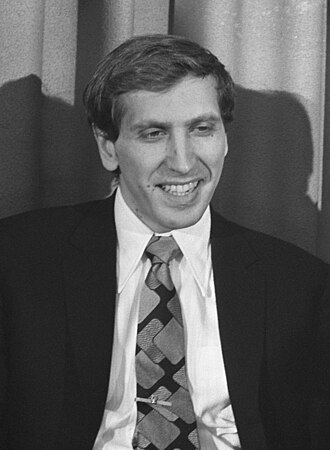
World Champion 1972–1975
Bobby Fischer
United States · 1943–2008
Bobby Fischer was an American prodigy widely regarded as one of the greatest players of all time, whose 1972 victory over Boris Spassky broke decades of Soviet dominance before he withdrew from the game.
Career highlights
- World Champion 1972–1975
- Won the 1972 title match against Boris Spassky
- Achieved a then-record rating and a 20-game winning streak against elite opposition
Early Life
Robert James Fischer was born in Chicago in 1943 and grew up in Brooklyn, raised by his mother. He discovered chess at six and was soon utterly consumed by it. By thirteen he had won the “Game of the Century” against Donald Byrne; at fourteen he won the U.S. Championship; and at fifteen he became the youngest grandmaster the world had yet seen.
Rise to the Top
Through the 1960s Fischer was clearly among the world’s best, but clashes with organizers and the Soviet chess establishment repeatedly disrupted his progress. When he finally committed to the 1970–72 cycle, the result was one of the most dominant runs in the game’s history.
The road to Reykjavík
Fischer demolished his Candidates opponents, defeating Mark Taimanov and Bent Larsen by astonishing 6–0 shutouts before overcoming former champion Tigran Petrosian. No one had ever swept elite grandmasters so completely.
World Champion
The 1972 match
In Reykjavík in 1972 Fischer faced Boris Spassky for the title in a contest framed as a Cold War duel between East and West. After a chaotic start — a forfeited game and endless disputes — Fischer took control and won, becoming the first American-born World Champion and a global celebrity.
Forfeiting the title
Fischer never defended the crown. Unable to agree terms with FIDE for a 1975 match against Anatoly Karpov, he forfeited the championship without playing a move, and withdrew almost entirely from public life.
Playing Style
Fischer combined relentless preparation, crystalline technique, and an iron will to win from any position. His play was direct and concrete, free of unnecessary risk yet utterly uncompromising. At his peak his results — including a streak of twenty consecutive wins against top opposition — bordered on the superhuman.
Later Life and Legacy
Fischer became a recluse, resurfacing only for an unofficial 1992 rematch with Spassky, after which legal troubles left him stateless; he spent his final years in Iceland, where he died in 2008. His combination of transcendent talent and tragic later life makes him one of the most studied and debated figures the game has ever known.
Portrait via Wikimedia Commons.