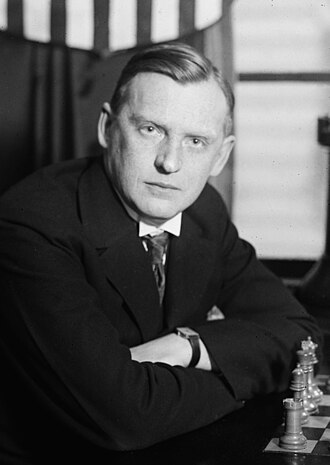
World Champion 1927–1935, 1937–1946
Alexander Alekhine
Russia, France · 1892–1946
Alexander Alekhine was a fierce attacking genius who dethroned Capablanca and is the only World Champion to die while holding the title, famed for combinations of extraordinary depth and imagination.
Career highlights
- World Champion 1927–1935 and 1937–1946
- Defeated José Raúl Capablanca in 1927
- The only champion to die while holding the title
Early Life
Alexander Alekhine was born in Moscow in 1892 into a wealthy, well-connected family. He learned chess as a child and was soon obsessed, playing by correspondence and studying late into the night. By his late teens he was among the strongest players in Russia, and the turmoil of the Revolution and Civil War — during which he was briefly imprisoned — eventually drove him to emigrate and take French citizenship.
Rise to the Top
In the 1920s Alekhine established himself as the most dangerous attacking player in the world, winning major tournaments at San Remo and Bled by enormous margins. Unlike the seemingly effortless Capablanca, Alekhine succeeded through ferocious will and unprecedented depth of preparation, analysing openings and adjourned positions with a thoroughness no one had matched.
World Champion
Dethroning Capablanca
In 1927, in Buenos Aires, Alekhine achieved what almost everyone thought impossible: he defeated the “invincible” José Raúl Capablanca over thirty-four gruelling games. It was a triumph of preparation and stamina over pure talent, and it made him the fourth World Champion.
Loss and recovery
He defended the title twice against Efim Bogoljubov, then suffered a shocking defeat to the Dutch amateur Max Euwe in 1935, during a period marred by heavy drinking. Alekhine reformed his habits, prepared meticulously, and regained the crown convincingly in their 1937 rematch — the only champion ever to win the title back after losing it in a match.
Playing Style
Alekhine’s games are monuments of attacking imagination. He wove deep, multi-piece combinations out of richly complex middlegames, often sacrificing material for an initiative he calculated to the end. His annotations, collected in volumes that remain classics of chess literature, reveal a mind of extraordinary tactical and strategic range.
Later Life and Legacy
The Second World War scattered the chess world, and Alekhine’s conduct during the occupation — including articles published under his name — remains a stain on his reputation. He died in Portugal in 1946, alone and still holding the World Championship, the only champion to do so. His death left the title vacant and forced FIDE to organize the 1948 tournament that would reshape the modern championship.
Portrait via Wikimedia Commons.