
Endgames are where games are won, yet they are the part most players study least. The good news: king and pawn endgames obey a small number of precise rules. Learn them once and you will never guess again.
The opposition
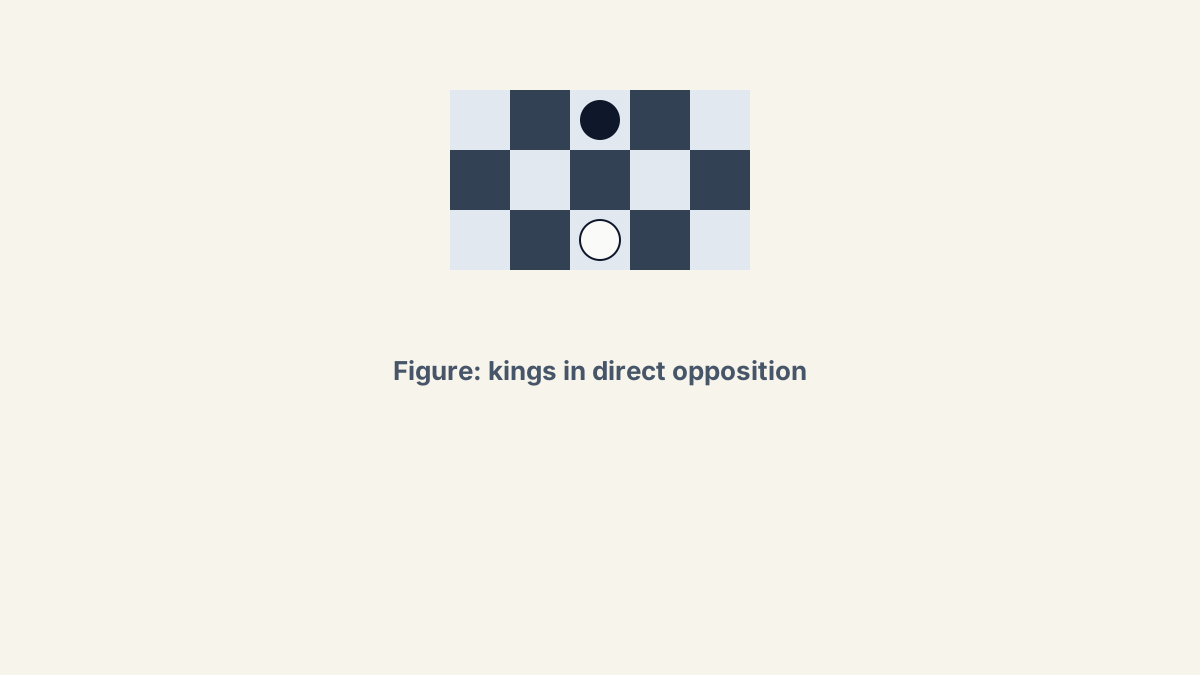
When the two kings stand on the same file with one square between them, the side not to move holds the opposition. The player forced to move must give ground, and in many positions that single tempo decides the game.
Direct and distant opposition
Direct opposition is the face-off above. Distant opposition works the same way across an odd number of squares — count the squares between the kings, and if it is odd and it is your opponent’s move, the opposition is yours.
- Same file, one square apart → direct opposition.
- Same file, three or five squares apart → distant opposition.
- Whoever does not have to move is in control.
The rule of the square
To know whether a lone king can catch a passed pawn, draw an imaginary square using the pawn’s path to promotion as one side. If the defending king can step into that square, it catches the pawn. If not, the pawn queens.
No counting moves, no calculation. The square tells you the answer at a glance.
Applying it under time pressure
This is the single most useful shortcut in practical endgames. When your flag is hanging, you do not have time to calculate a king march — but you always have time to glance at the square.
Key squares
Every passed pawn has a set of key squares. If your king reaches one of them, the pawn promotes regardless of whose move it is.
- For most pawns, the key squares sit two ranks ahead of the pawn.
- Get your king there first and the win is automatic.
- The opposition is simply the tool you use to fight for those squares.
Put the three ideas together — opposition to win the tempo battle, the square to defend, key squares to attack — and king and pawn endgames stop being a lottery. They become arithmetic.